How Is Corrugated Cardboard Produced?
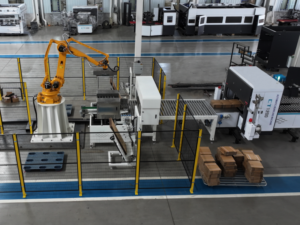
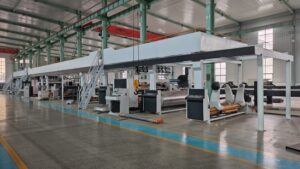
Corrugated board, which can be seen everywhere in daily life, may seem simple in structure, but its production involves a coherent and precise assembly line process. It is formed step by step entirely by a Corrugated Cardboard Production Line without redundant manual splicing, and every step is designed to ensure the hardness, toughness and flatness of the board.
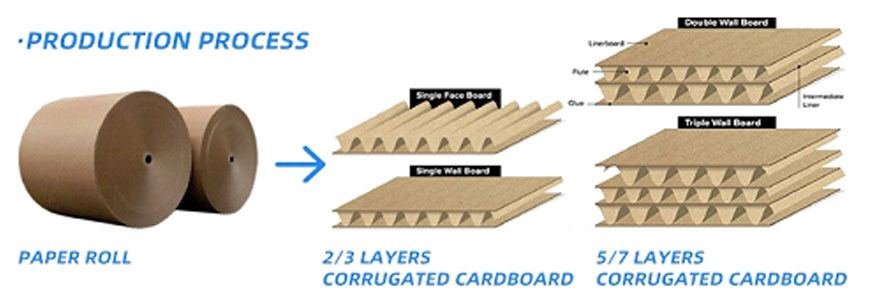
Production starts with raw material preparation. The main material used is roll-based base paper, divided into corrugating medium for structural support and linerboard (including outer and inner liners) for protection. These base papers first undergo preheating to adjust their internal moisture content to an appropriate range, preventing warping and delamination during subsequent forming. At the same time, a tension control system ensures stable paper conveyance without deviation or wrinkling.
Next comes the core corrugating process. The corrugating medium is fed between a pair of high-temperature rollers with corrugated profiles. Under combined pressure and heat, the flat medium is instantly formed into uniform waves, known as the corrugated flute. The crests of the formed flute are then evenly coated with eco-friendly starch adhesive, with the glue volume precisely controlled to ensure strong bonding without soaking through the paper.
The glued flute is immediately bonded to the inner liner to form single-face corrugated board. For thicker 5-ply or 7-ply board, multiple sets of single-face corrugated layers are sequentially laminated with outer liners. The laminated board then passes through a high-temperature hot-pressing section, where the adhesive cures rapidly, bonding all layers firmly together, while further drying and setting removes excess moisture.
Finally, the full-width board is precisely cut to required dimensions via cross-cutting and slitting, with edge trims removed to produce standard-sized sheets. After a simple flatness inspection, qualified products free of delamination, damage or deformation complete the entire production process and can be further processed into various packaging boxes.
 Longcheng Carton Machine